
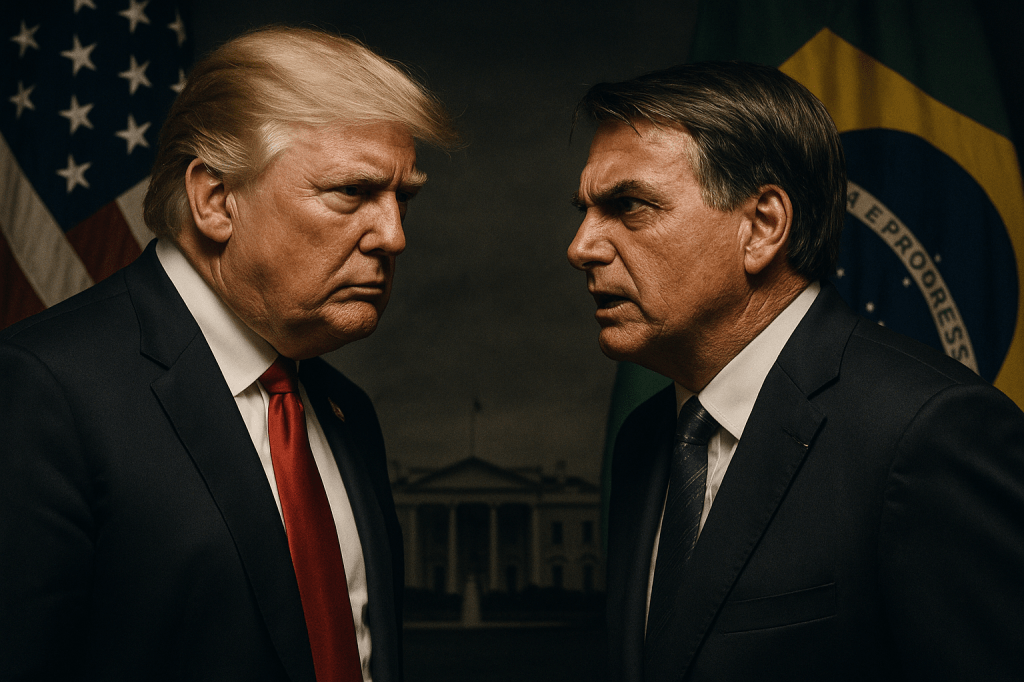
Donald Trump’s decision to impose retaliatory tariffs on Brazil in response to Jair Bolsonaro’s prosecution marks a new escalation in the international campaign against Lulism—understood here not only as a political programme, but as a global symbol of a threatened progressive order. To grasp the depth of this confrontation, it is necessary to look back at the history of Brazil–US relations, shaped by geographic proximity and longstanding ideological alignments.
Beginning in the so-called “age of nationalisms,” particularly during the Getúlio Vargas era (1930–1945) and later under President Eurico Gaspar Dutra (1946–1951), Brazil began its long journey of political alignment with the United States. Dutra’s presidency marked the start of a doctrine positioning Brazil as a key player in Washington’s “backyard” during the Cold War. American interference took on more explicit contours with the 1964 military coup that ousted João Goulart—an operation supported logistically and politically by the United States under President Lyndon B. Johnson, known as “Operation Brother Sam.”
This U.S. involvement was rooted in Cold War logic, aimed at curbing the spread of communism—particularly in what Americans viewed as their strategic “southern garden.” It reflected the Monroe Doctrine’s hemispheric hegemony and the National Security Doctrine, which justified interference in sovereign states under the guise of defending democracy and U.S. interests abroad.
With the fall of the Berlin Wall and the wave of democratisation across the globe, Brazil entered a new phase in its relationship with the U.S. during the administrations of José Sarney, Fernando Collor de Mello, Itamar Franco, and Fernando Henrique Cardoso. This was a period marked by cooperation, economic liberalisation, and adherence to the principles of the Washington Consensus, as Brazil embraced globalisation.
The era of Luiz Inácio Lula da Silva ushered in a new chapter. Brazil gained significant symbolic capital both within the BRICs—where it emerged as a rising economic power and a voice of the Global South—and during Barack Obama’s presidency, in which Lula was seen as a progressive democratic icon with a strong labour-oriented ethos.
Donald Trump’s rise to power amid a broader wave of right-wing illiberalism across the West paved the way for Jair Bolsonaro’s ascent in Brazil. This established a new American–Brazilian ideological axis rooted in shared illiberal values. In the Brazilian case, this was compounded by an explicit nostalgia for the military dictatorship and a symbolic rehabilitation of authoritarianism as a tool of “order” and “patriotism.”
It is within this context that Trump’s new 50% tariffs on all Brazilian imports—set to take effect on 1 August 2025—must be understood. These tariffs, framed as retaliation for Bolsonaro’s prosecution, which Trump has denounced as a “witch hunt,” are not purely economic—they are profoundly political.
This move serves a dual purpose. On one hand, it is an attack on multiculturalism and “cultural Marxism,” of which Lula is a prominent global representative. Brazil has become fertile ground for this ideological clash. On the other, the sanctions appear designed to bolster Bolsonaro’s possible return to power—a figure wholly aligned with Trump’s worldview—reinforcing an American-led axis of political and cultural hegemony in the region. In this way, the use of economic sanctions becomes a tool of ideological coercion, reflecting the increasing overlap between economic warfare and cultural warfare in illiberal regimes.
Brazil is once again a stage for global ideological confrontation. On one side stands the nationalist, autocratic right—Trump, Orbán, Le Pen, and, in different circumstances, Putin and Xi. On the other, multiculturalism and the globalist agenda, now maintained more by institutions than individual figureheads. Within this dynamic, Brazil is not just a mirror, but a laboratory where the battles between liberal democracy and contemporary authoritarianism become more visible—and more acute.
 © The Political Crow
Deixe um comentário