
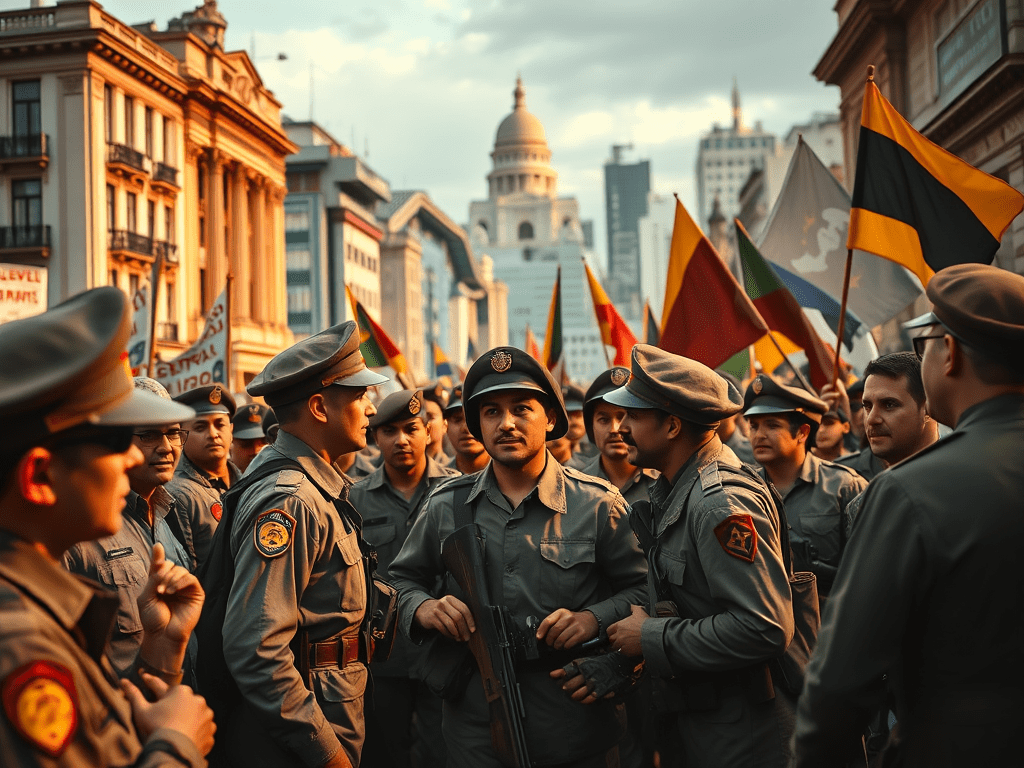
The 1924 Revolution, also known as the Second Tenentist Revolt, stands as one of the most significant and complex episodes in the political and social history of Brazil during the First Republic. Although commonly associated with the tenentist movement—primarily of a military nature—the uprising that took place in São Paulo in July of that year revealed a broader social and political composition that transcended the barracks and included organized civil sectors, particularly the urban working class.
As various scholars have pointed out, the tenentist phenomenon, although heavily militarized, was not confined to the ranks of the armed forces. The 1924 uprising in São Paulo exposed this heterogeneity by bringing soldiers, officers, and civilian workers together, revealing political and social motivations that, while not always convergent, found common ground in shared demands.
Unlike the 1922 Copacabana Fort Revolt in Rio de Janeiro, which was led exclusively by military personnel, the São Paulo uprising incorporated elements of the working class and civil society. This integration challenges the interpretation that attributes an exclusively militaristic character to the tenentist rebellions and demonstrates that the movement also expressed broader democratic, social, and labor-related demands.
Historian Maria Clara Spada de Castro, in her doctoral dissertation, emphasized that civilian participation in the 1924 uprising was neither accessory nor subordinate, but rather played a coordinating role in crucial moments of the conflict. Ordinary citizens and labor leaders not only provided logistical support to the uprising but were also at the forefront of political and armed actions. The names of Waldomiro Rosa and Pedro de Alcântara Tocci stand out as examples of civilian leaders who played key roles in the revolt.
The publication of the «Manifesto to the Workers of the Labor Party,» dated July 23, 1924, is one of the documents that attest to this tactical alliance between the military and São Paulo’s working class. This public declaration of shared objectives evidences the collective character of the uprising and the pursuit of structural change within the political regime.
The demands that brought together tenentist and civilian forces revolved around structural reforms, such as the expansion of civil liberties (suffrage, freedom of the press, freedom of thought, academic freedom, and freedom of publication), the extension of political rights to women, the nationalization of production, agrarian reform, labor legislation, and educational reform. These demands reveal not only the heterogeneity of the uprising but also its insertion in the broader crisis of the First Republic, which was facing increasing political erosion and loss of legitimacy.
The communist and anarchist groups, initially hesitant to support the movement—viewing it as led by petty bourgeois and nationalist military officers—began to reconsider the possibility of forming tactical alliances in the face of increasing repression and the strategic opportunity to break with the oligarchic order. Communist leader Octávio Brandão stated in an interview with John Foster Dulles that Colonel Isidoro Dias Lopes personally traveled from São Paulo to Rio de Janeiro to persuade the leadership of the Brazilian Communist Party (PCB) to support the imminent uprising. He reportedly met with Astrojildo Pereira, then the party’s secretary-general.
Although negotiations did not advance—mainly due to fears that the PCB’s armed forces might gain autonomous momentum—the mere attempt to articulate support illustrates the ideological fluidity and strategic considerations present at the time.
One often overlooked aspect in mainstream historiography is the internationalist composition of part of the armed resistance. The so-called Foreign Battalions, organized by workers of various nationalities—many of them World War I veterans—played a significant role in sustaining the revolt. Their technical expertise was instrumental in the construction of improvised armored vehicles and explosives, which were crucial in resisting the legalist forces for nearly a month.
The legacy of the 1924 Revolution is ambivalent. On the one hand, the revolt exposed the fragility of the oligarchic pact that defined the First Republic and highlighted growing dissatisfaction with the political regime. On the other hand, the conflict was followed by intensified repression. Authorities, under the pretext of restoring public order, expanded social control mechanisms, increased public security expenditures, and created institutions such as the Department of Political and Social Order of São Paulo (Deops/SP), which soon became known for its role as a vigilant and repressive political police.
This repressive policy had the side effect of criminalizing dissenting political practices, which were framed as threats to state security and thereby delegitimized—even when rooted in legitimate demands for institutional reform.
The 1924 Revolution in São Paulo represents, from a historiographical standpoint, a critical milestone in the transition from the oligarchic dominance of the First Republic to the cycle of contestation that culminated in the 1930 Revolution. Its significance lies not only in its military impact or urban violence but also in the unprecedented articulation between dissident military sectors and the urban working class.
This confluence reveals the potential for political alliances between seemingly antagonistic groups, united by shared criticisms of institutional conservatism and a desire for social transformation. Understanding this episode sheds light on the limitations and contradictions of the conservative modernization process that characterized Brazil in the subsequent decades.
 © The Political Crow
Deixe um comentário