
Law often lags behind reality. This is a well-known maxim in legal theory: laws emerge, for better or worse, as responses to new and evolving social challenges. Politics, too, is meant to offer such responses—through negotiation among competing forces in search of what has been called “common ground.”
However, the rise of populist and demagogic movements has disrupted this process. In such contexts, “political facts” are no longer the product of pressing, undeniable realities, but often fabricated events—crafted to stir division and signal ideological belonging.
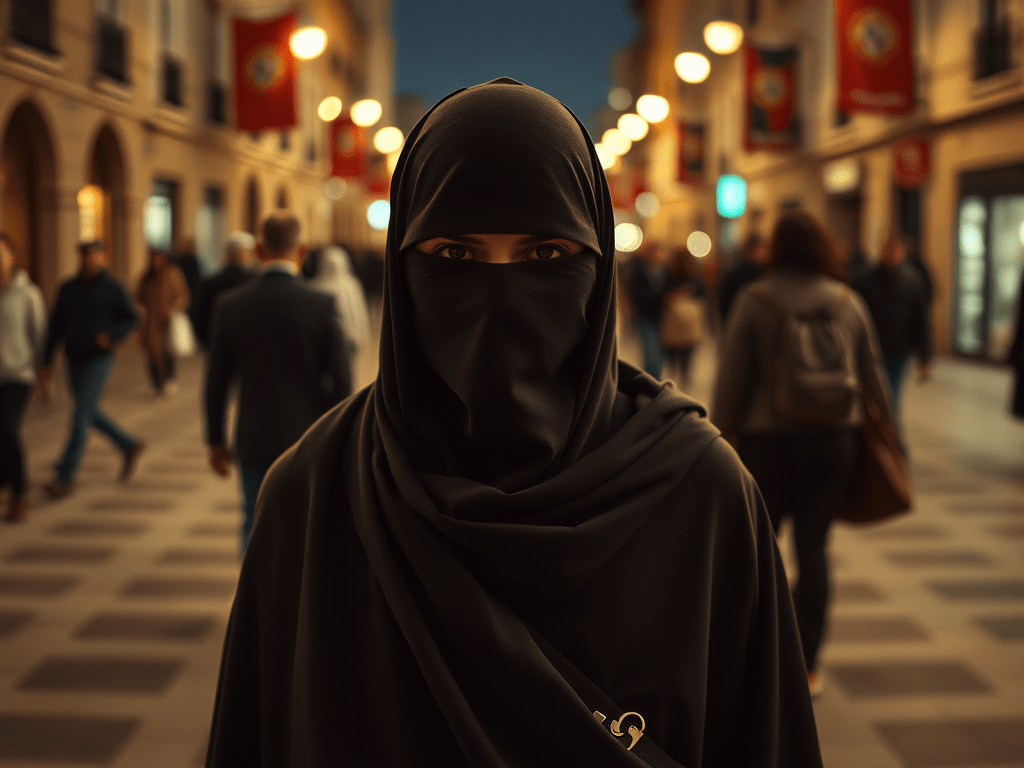
That is precisely where we find ourselves with a recent bill proposed by the far-right Chega party in Portugal. It aims to ban face coverings in public spaces—even when worn for religious reasons.
Though the bill is framed around public safety concerns—arguing that face coverings may hinder criminal investigations—it can be more accurately understood as an attempt to manufacture a political issue where none exists. On social media, party members have made it clear: this isn’t about all forms of face coverings; it’s specifically about banning the burka.
So, how is this a fabricated issue? Simply put: the burka is not a common sight in Portugal. One might argue that Chega is attempting to anticipate future problems. But in light of the party’s track record, it’s more plausible that this is part of a broader strategy to sustain a constant sense of cultural alarm. After the governing coalition (AD) took on the politically charged topics of immigration and citizenship law—triggering constitutional concerns and accusations of yielding to nativist pressure—Chega had to raise the stakes. What better way than to import a moral panic from other European contexts?
What’s telling is how the party justifies this measure: by positioning it as a feminist act, a defense of women’s rights against religious oppression. The bill states that anyone who forces another person to cover their face through threats, coercion, or abuse—specifically based on sex—should be punished under the criminal code for aggravated assault.
At the same time, the bill frames secularism as a justification for banning religious symbols in public institutions—schools, hospitals, public transport, and other state-run facilities. Here, Chega merges two traditionally contradictory lines of the radical right: an aggressive secularism aimed at Islam, and a nostalgic Christian nationalism seen in leaders like Viktor Orbán.
This rhetorical juggling act is part of a broader far-right strategy observed across Europe: embracing temporary “homonationalist” and “femonationalist” narratives—terms analyzed by Jean-Yves Camus and Nicolas Lebourg (2017), and by Sara R. Farris in In the Name of Women’s Rights (2017)—to defend so-called “civilizational values” against the threat of Islam.
This supports the view, articulated by theorists like Ernesto Laclau, that populism is less a coherent ideology than a flexible form of discourse and representation, built around a constant “us vs. them” logic. It is a political method that molds itself to the moment, always claiming to represent “the people” against elites, outsiders, or invented threats.
In the end, this bill is not about public safety, gender equality, or religious freedom. It is about staking ground in an imported culture war—and feeding the fire of identity politics with borrowed symbols. A classic maneuver in the ever-shifting playbook of the radical right.
Camus, J.-Y., & Lebourg, N. (2017). Far-Right Politics in Europe. Cambridge, MA: Harvard University Press.
Farris, S. R. (2017). In the Name of Women’s Rights: The Rise of Femonationalism. Durham, NC: Duke University Press.
Laclau, E. (2005). On populist reason. Verso.
 © The Political Crow
Deixe um comentário