
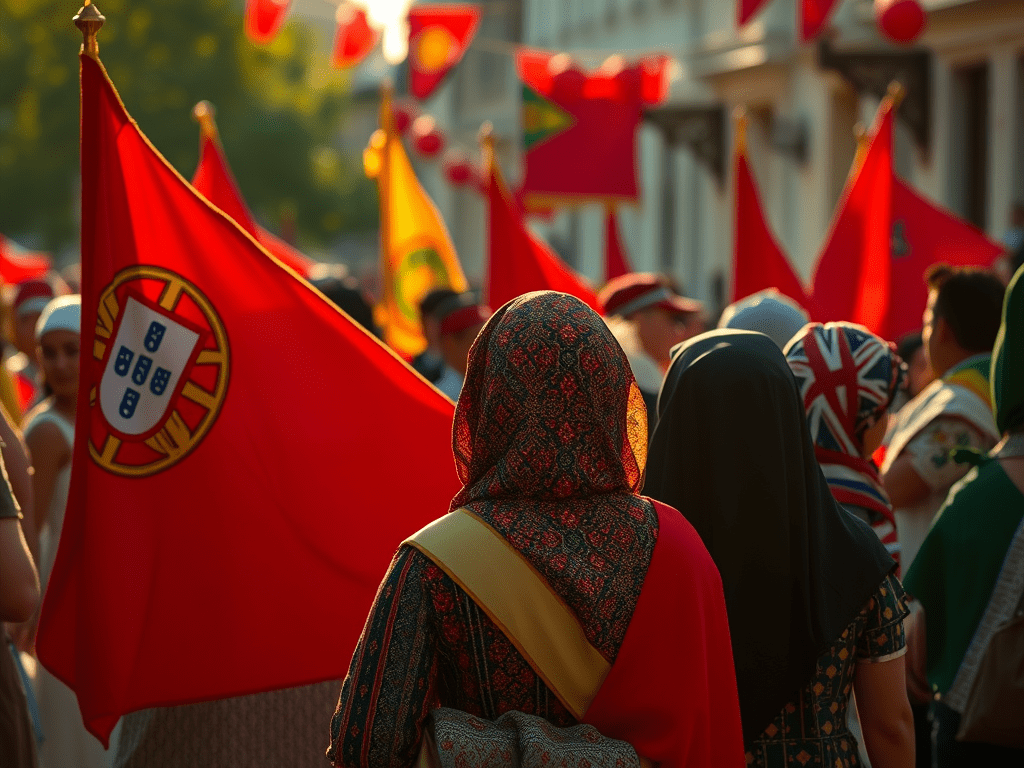
The reasons behind polarization are well known, and the literature has extensively documented them. They range from divergent social rhythms across regions of the West—even within countries, as seen in the contrast between urban America and the rural Midwest—with tensions between progressivism and a conservative cultural backlash around moral issues (the so-called culture wars), such as abortion, same-sex marriage, and the highly politicized issue of gender identity, to more material concerns related to migratory flows and cultural clashes.
The cultural dimension is the central node in this debate. Multiculturalism emerged as a concept aimed at explaining the dynamics of cultural encounters and hybridization resulting from the shift toward a “global village,” spurred by accelerated migration flows to the Global North. It became the natural consequence of cultural exchange and growing diversity that increasingly characterized Western societies—especially in major cities across Europe and North America. These were human flows and counterflows weaving new social fabrics.
However, critical voices emerged early on. In the 1970s, Alain de Benoist, architect of the European New Right (although far more philosophically sophisticated than today’s new right), raised concerns. In the 1980s, it was Alasdair MacIntyre, and in the 1990s, Samuel P. Huntington. They shared a common worry: the challenges multiculturalism posed to local identities and to a broader European identity. These ideas would later be taken up by others in the 21st century—Giovanni Sartori, for instance, who viewed multiculturalism as a dangerous illusion that underestimates the difficulties of integrating migrants from vastly different cultures; Renaud Camus, who developed the “Great Replacement” theory, now the ideological cornerstone of the post-Benoist New Right, based on the idea that there is an intentional political program to replace European populations with Muslim immigrants; and Roger Scruton, who regarded immigration as a threat to the stability and survival of liberal Western democracies, potentially leading to the erosion of the legal order and established social norms.
This line of thought stands in opposition to a counter-hegemonic perspective derived from the ideas of Antonio Gramsci, which have significantly influenced notions of “global citizenship” and cultural relativism. The Gramscian view, which sees hegemony as the cultural domination exercised by elites over subordinate classes, provided a theoretical foundation for challenging structures of power that promote cultural homogeneity and exclude marginal voices. Within this framework, multiculturalism—for Gramscian and postcolonial thinkers—is not seen as a source of social fragmentation or decline, but rather as a necessary response to Western cultural hegemony and imperialism.
Cultural relativism, as advocated by postcolonial thinkers such as Edward Said and Amartya Sen—both strongly influenced by postmodernism—argues that within multiculturalism, it is not enough to give voice and emancipation to those historically subjugated by Western imperialism. One must also adopt a relativistic stance toward the customs, norms, and social standards of migrant communities, even when these conflict with those of the host societies.
From this tension emerge two largely incompatible visions: on one side, a reactionary stance toward immigration and multiculturalism, advocating for the full assimilation of migrants and refugees into prevailing social norms, relegating religion to the realm of personal conscience and individual freedom; and on the other, an ultraprogressive view that sees hegemonic social norms as a continuation of Western colonial and imperial oppression, and is reluctant to acknowledge that large-scale migration poses inevitable challenges.
It is this tension that spills into the central café—through the television, the newspaper on the table, and the opinions exchanged at the counter. Their inherently reductive and simplistic nature is readily channeled by populist movements. Moral panic, sensationalist headlines on crime, and the visible presence of the “other” in spaces once marked by extreme uniformity all contribute to a rise in anti-immigrant sentiment.
However, research I conducted—whose results will be published in 2025—shows that among political elites, commentators, and other prominent figures, strongly polarized views are virtually absent. The clichéd portrayals of an “antinationalist left” committed to the Great Replacement and a reactionary right that rejects all immigration do not hold up. On the contrary, there is a clear concern with avoiding both extreme cultural relativism—which could be used to justify practices that violate human rights—and the rigid imposition of Western values that ignores the cultural particularities of migrants.
There is, therefore, an emerging consensus: immigration is necessary; peoples have the right to their cultural identities; but above all, human rights, the Constitution, and the legal framework must prevail. It is true that more radical actors feed the culture wars: on the left, by downplaying cultural differences and viewing capitalism as the source of all oppression; on the right, by pushing hard assimilationist narratives. But these are more the exception than the rule.
Nonetheless, one must recognize that once the issue enters the central café, it rarely leaves. And Portugal is only now taking its first steps into large-scale, culturally diverse migration. There are lessons to be learned—from both the successes and the failures—of countries that have already walked this path. Therefore, although the most radical political actors may have lost the culture war, even within their own camps, the situation can change rapidly if Portugal fails to implement a full, coordinated, and rights-based integration process—one that upholds the dignity of those who arrive, the primacy of human rights, and acknowledges legitimate concerns about local and national cultural identity. Letting the immigration debate slide into polarization means surrendering it to culture wars and populism. And nothing good ever comes of that.
 © The Political Crow
Deixe um comentário